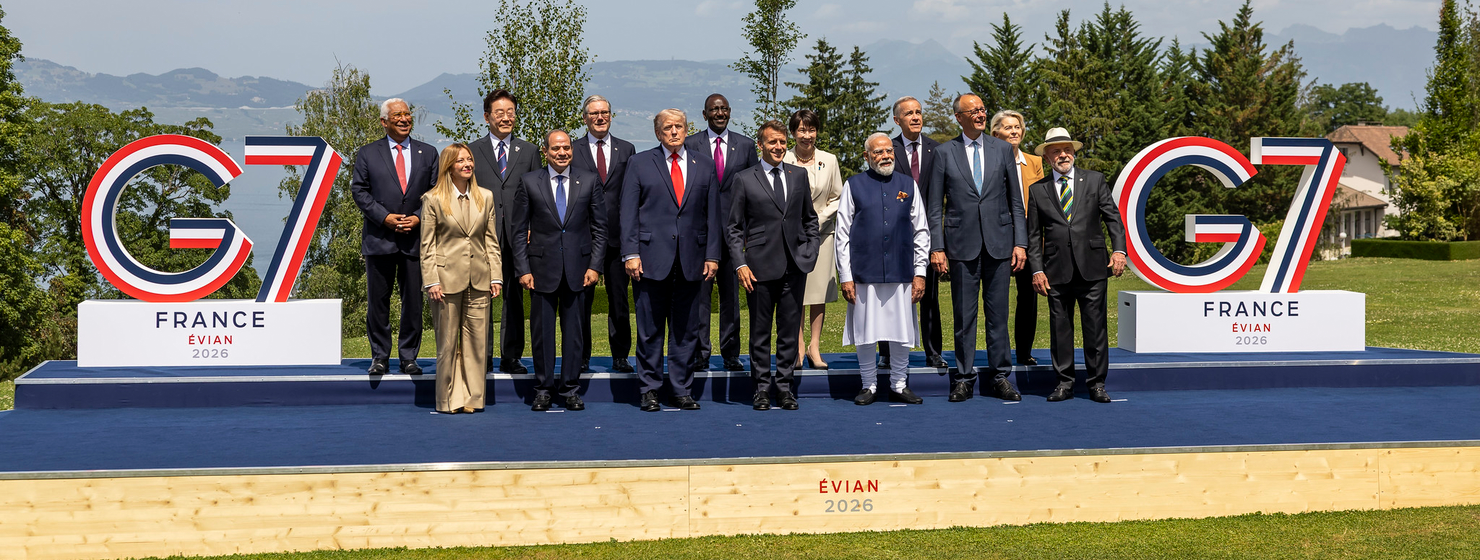
Following the G7 Summit in Évian in June 2026, heads of state and government underlined the strategic importance of critical minerals for economic prosperity, energy systems and global security. Against the backdrop of geopolitical tensions, concentrated supply chains and increasing trade restrictions, access to critical raw materials has evolved from an industrial challenge into a key political issue. In their Declaration on Securing Supply Chains for Critical Minerals following the Summit, the G7 leaders stressed the urgency of diversifying supply chains, reducing critical dependencies and strengthening collective resilience. In this context, rare earths and permanent magnets are specifically highlighted as a priority area.
Several European research and innovation projects are already addressing these challenges by developing more resilient, sustainable and circular value chains for rare earth permanent magnets. These materials are essential for a wide range of strategic applications, including electric mobility, renewable energy technologies and advanced industrial solutions.
Steinbeis Europa Zentrum, communications partner in GREENE, recently published a press release outlining how several EU funded projects are contributing to more sustainable and resilient value chains for rare earth magnets.
Among the featured projects is GREENE, which aims to reduce the use of critical raw materials in permanent magnets while maintaining or even enhancing their performance. To achieve this, partners are re-engineering the microstructure of Nd-Fe-B permanent magnets through innovative approaches such as intelligent modelling, in-situ grain boundary diffusion, and rapid consolidation.
Alongside GREENE, Steinbeis Europa Zentrum and several GREENE partners including Jožef Stefan Institute and Pforzheim University are also involved in further EU-funded projects like REEsilience and HARMONY. Both projects address complementary challenges across the rare earth magnet sector.
REEsilience is dedicated to building a resilient supply for RE magnets, encompassing the entire value chain. Project partners are developing ICT-supported technologies for the production of alloys and powders, improving the transparency of material flows and implementing automated processes for magnet production to increase production capacity in Europe. At the same time, the project is focused on increasing recycling rates, developing magnets with enhanced capabilities and building the skills needed for the next generation of magnet experts.
HARMONY focuses on building a pilot-scale recycling loop for permanent magnets in Europe. It combines novel, shorter direct recycling processes, such as hydrogen processing of magnet scrap (HPMS), with innovations in traditional pyrometallurgy and hydrometallurgy. The project covers the entire value chain, from the collection and disassembly of magnet-containing waste to the recovery of rare earth elements and the production of new sintered and bonded magnets. Solutions developed are being tested in various industrial applications under relevant real-world conditions.
Together, GREENE, REEsilience and HARMONY demonstrate how European research and innovation can translate high-level political priorities into practical solutions. By improving material efficiency, increasing recycling capacities and supporting circular value chains, these projects contribute to a more sustainable, secure and resilient supply of rare earth permanent magnets in Europe.