GREENE Results
This page presents significant project developments and main project output. Also check out our Zenodo community for all uploads!

GREENE’s vision is to secure Europe’s green and digital future by making permanent magnets for key industries such as e-mobility and renewable energy more sustainable and resilient. By combining smart predictions, innovative materials and advanced characterisation tools, the project redesigns magnets to use materials more efficiently while maintaining high performance, including when using recycled sources. GREENE will develop and validate these solutions in the lab and scale them up with industrial partners. The most promising results will be taken closer to market after the project, supported by modular solutions and a dedicated skills strategy to strengthen Europe’s industry.
PROGRESS UPDATE
To stay up to date on GREENE, we invite you to follow our LinkedIn page, where you can also subscribe to our newsletter.
May 2026
At the M24 meeting in Parma, the GREENE consortium reviewed the progress achieved across all work packages and defined the next strategic steps toward the development of sustainable, RE-lean (≤30 wt. %) high-performance rare-earth permanent magnets for traction motor applications.
Significant scientific progress was reported within the first work package dedicated to multiscale simulations, where partners proposed a novel strategy to independently tailor the intrinsic properties of the Nd2Fe14B (2:14:1) hard-magnetic phase and the grain-boundary phases. The objective is to optimize both intrinsic and extrinsic magnetic properties while simultaneously reducing strain-stress interactions at grain boundaries. The consortium highlighted that only a limited amount of excess rare-earth content is necessary to form effective grain-boundary phases capable of magnetically decoupling neighboring grains, while carefully selected grain-boundary wetting promoters remain essential for establishing continuous grain-boundary networks.
Research activities in the next work packages – dedicated to the synthesis of feedstock and of “bulk”-embedded magnetic surfaces – continued to focus on the development of 2:14:1 single-crystal feedstocks approaching theoretical anisotropy fields, and on complementary alloy systems based on engineered grain-boundary phases and diffusion couples. In this context, the first successful physical vapor deposition (PVD) coating of 2:14:1 single-crystal feedstocks was demonstrated, opening new opportunities for tunable Nd-Fe-B grain-boundary-engineered systems.
These developments are closely connected with the work package dedicated to novel magnet production methods, where the consortium successfully demonstrated both conventional and radiation-assisted sintering routes on non-HRE-containing RE-lean feedstocks. Importantly, the results showed that the targeted magnetic properties can be achieved using heating cycles lasting only several minutes, instead of conventional multi-hour high-temperature treatments. This significant reduction in processing time not only suppresses detrimental grain growth but also represents an important step toward more energy-efficient and sustainable magnet manufacturing. In addition, in the work package dedicated to advanced analysis methods, the first magnetization microscopy measurements were performed on a model Nd2Fe14B system with alternating grain boundaries, providing new insights into local magnetic interactions and grain-boundary functionality.
At the application level, guidelines from industrial partners BOSCH and Magneti Ljubljana further refined the magnet properties and design for later traction motor integration strategy, aligning material and process development in these work packages with European industrial requirements and performance targets. At the same time, the consortium continues to advance the upscaling of production routes for both fresh and recycled powders, and the work package dedicated to sustainability published a baseline Life Cycle Assessment (LCA) study, highlighting the value of the non-HRE and RE-lean GREENE approach as an important step toward establishing robust and more sustainable European value chains for permanent magnets.
Beyond technical progress, GREENE partners have remained highly active in spreading knowledge and early results, engaging stakeholders, and preparing the future use of project results. With the first scientific publication already released and several others currently under preparation, the project continues to strengthen its scientific visibility and industrial impact. Another highlight is the strong collaboration with related projects and initiatives, including joint educational activities for students and young professionals developed together with BEETHOVEN and MagNEO through the “Talking Magnets” series. The next session may take the form of a Spring School in May 2027. We warmly invite inerested participants to get in touch if they would like to contribute to or attend the programme.
April 2026
2 New Project Deliverables have been published!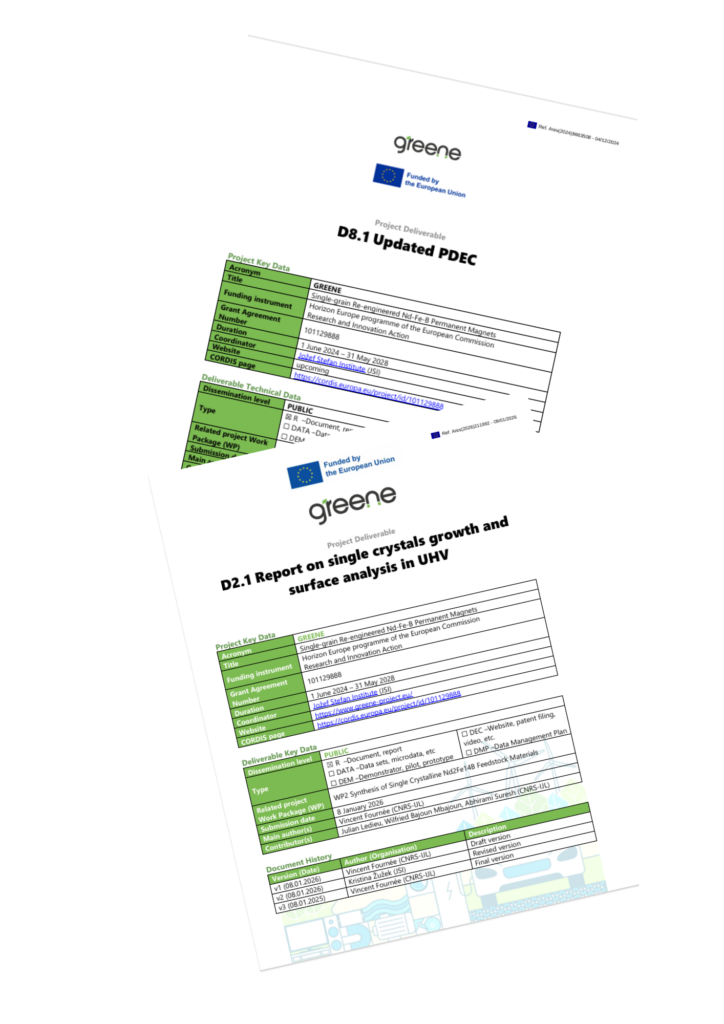
Project Deliverable D2.1 Report on single crystals growth and surface analysis in UHV
Nd-Fe-B permanent magnets are vital for Europe’s green energy transition but face supply chain and sustainability challenges. This deliverable summarizes the successful growth and atomic-level surface analysis of Nd₂Fe₁₄B single crystals, laying the groundwork for advanced, sustainable magnet interfaces.
Project Deliverable D8.1 Updated PDEC
This deliverable provides the M6 update of GREENE’s Plan for Dissemination, Exploitation and Communication (PDEC), outlining target groups, actions, tools, and procedures to maximise project impact, visibility, skills development, and compliance with Horizon Europe and GDPR requirements.
September 2025
We have just started our second project year, and have made considerable progress already.
We started by laying the foundation with multiscale modelling, evaluating how magnetocrystalline anisotropy and coercivity depend on strain and atom substitution. This allowed us to identify the theoretically most resilient microstructures against reverse magnetization. We have already conducted preliminary microstructure redesign experiments to process novel Nd-Fe-B permanent magnets.
The first results are promising: the resulting microstructures are free of heavy rare earths (HREs), contain a reduced total RE content, and already show encouraging magnetic properties.
Read more in our 1st newsletter on LinkedIn!
SCIENTIFIC PUBLICATIONS
Matej Komelj, et al. “Influence of strain and correlation effects on the magneto-crystalline anisotropy of Nd2Fe14B.” Journal of Magnetism and Magnetic Materials, Sept. 2026, doi: 10.1016/j.jmmm.2026.174460
Srsan, Vinko, et al. “Oscillating topological charge for skyrmion-based spin-transfer torque nano-oscillator.” Journal of Magnetism and Magnetic Materials, Volume 654, Sept. 2026, doi:10.1016/j.jmmm.2026.172363
Tomše, Tomaž, et al.”In-situ Grain-Boundary Diffusion in Near-Equilibrium Nd-Fe-B Powders for High-Coercivity Reprocessed Magnets.” IEEE Transactions on Magnetics, June 2026, doi: 10.1109/TMAG.2026.3706805
Samuel, Stellina, et al. “Mitigating the disproportionate environmental impacts and costs of dysprosium in Nd-Fe-B magnets through material efficiency.” Sustainable Production and Consumption, Apr. 2026, doi:10.1016/j.spc.2026.04.006.
PUBLIC TECHNICAL DELIVERABLES
Public technical deliverables are listed here once they have been approved by the granting authority.
Fournée V., Bajoun Mbajoun W., Suresh A., Ledieu J. (2025). D2.1 Report on single crystals growth and surface analysis in UHV. GREENE. Horizon Europe Grant No. 101129888, doi:10.5281/zenodo.19593657.
further outputs
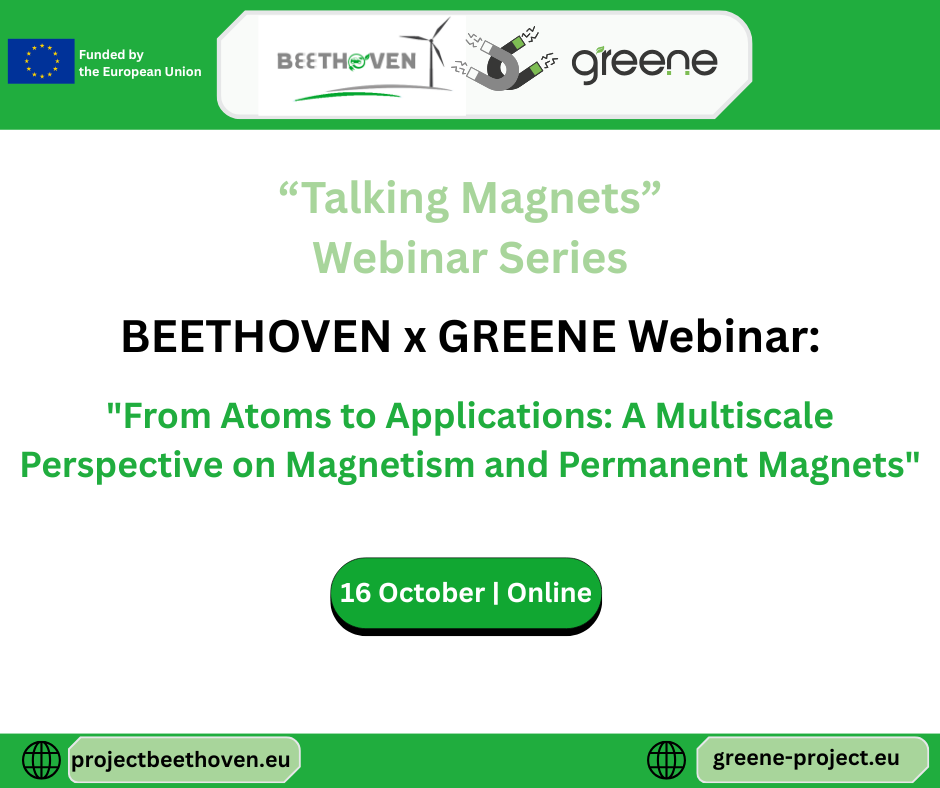
Presentations of the webinar ‘Talking Magnets: From Atoms to Applications – A Multiscale Perspective on Magnetism and Permanent Magnets‘ organised on 16th October 2025 by the EU-funded projects GREENE & BEETHOVEN can be downloaded here.