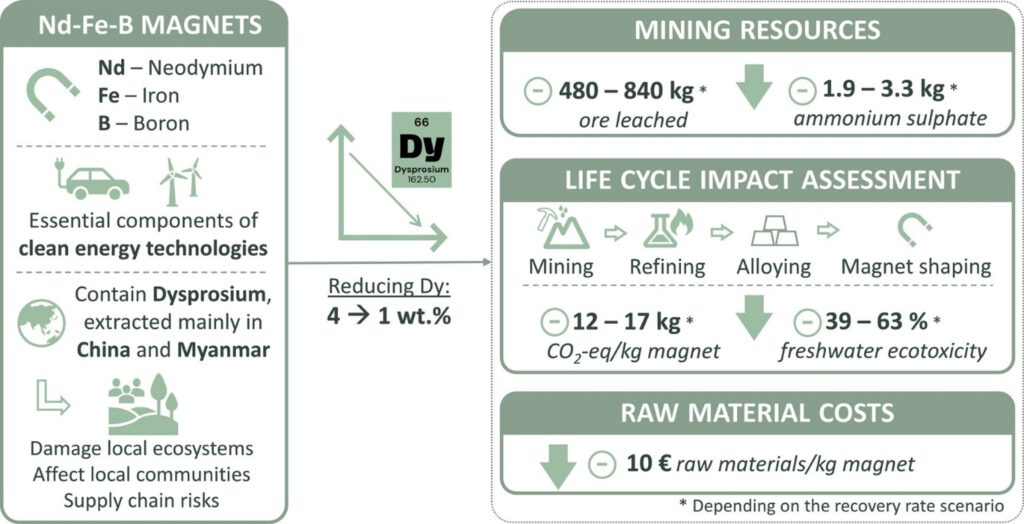
Ultra-high-grade neodymium‑iron‑boron (Nd-Fe-B) magnets are essential components of clean energy technologies, including electric vehicles and wind turbines. However, they often contain dysprosium (Dy), a heavy rare earth whose extraction poses environmental, social and supply risks. Dysprosium is often used in high-performance magnets because of its ability to maintain their magnetic strength and resist demagnetization, especially at high temperatures. It is classified as a critical raw material by the European Union.
Read the paper: Mitigating the disproportionate environmental impacts and costs of dysprosium in Nd-Fe-B magnets through material efficiency | Zenodo
Considering the high environmental impacts, reducing Dy content in magnets while maintaining the performance required for its applications is a critical step toward a sustainable energy transition. Material efficiency techniques such as grain boundary diffusion have already demonstrated that a similar performance can be reached with less critical raw material.
Dy is a heavy rare earth element added to Nd-Fe-B magnets to improve coercivity and prevent thermal demagnetisation in high-temperature applications.
The study “Mitigating the disproportionate environmental impacts and costs of dysprosium in Nd-Fe-B magnets through material efficiency” quantifies the life cycle environmental impact and raw material costs of manufacturing Nd-Fe-B magnets containing 1–8 wt% Dy.
The authors modelled Nd and Dy as separate supply chains in the magnet life cycle from extraction up until magnet manufacture. The results reveal that despite its low content, Dy mining contributes largely to the negative environmental impact of magnet production: contributing severely to land degradation, chemical pollution of freshwater and marine ecosystems.
The paper demonstrates that dysprosium (dy), despite making up only 1-8wt% of Nd-Fe-B magnets, is responsible for a disproportionately large share of their environmental impacts and costs, and that reducing its content through material-efficient magnet design can substantially improve sustainability while lowering costs. Reducing the Dy content from 4 wt% to 1 wt% in high-performance Nd-Fe-B magnets is technically conceivable by optimising their microstructure, using material efficiency techniques such as grain boundary diffusion.
The study highlights the environmental and economic benefits of using Dy more efficiently. Minimizing its content from 4 to 1 wt% could reduce emissions and other environmental impacts while lowering pressure on global supplies of this critical raw material. At the same time, it could reduce material costs by approximately €10 per kilogram of magnet.
With a growing demand for electric vehicles and renewable energy technologies, using dysprosium more efficiently will be crucial to ensure a sustainable and secure supply of materials for the energy transition. These findings highlight the importance of material-efficiency strategies, a key focus of GREENE, which seeks to reduce the use of critical rare-earth elements while preserving the magnetic performance required for applications such as electric vehicles and wind turbines.